Shop Flags Built for High Wind
2-Ply Polyester American Flag — Best for High Wind and Coastal Areas
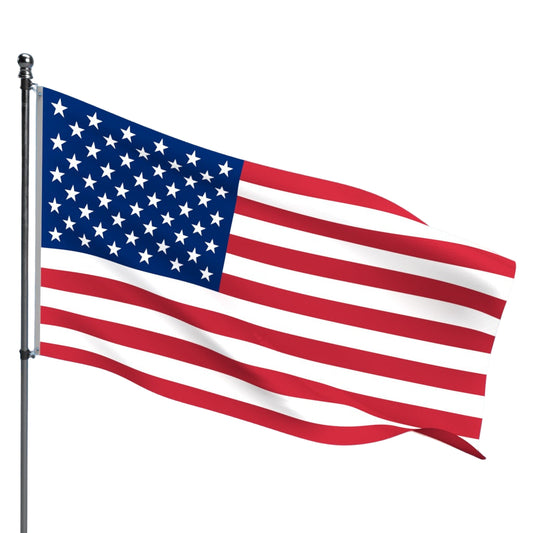
Our toughest flag, built from heavy 2-ply spun polyester — two layers of fiber twisted and woven together for maximum abrasion resistance and structural integrity in sustained wind. UV-resistant dyes, four-row lock-stitched fly end, heavy canvas header, and solid brass grommets with tooth washers. The flag for people who are done replacing flags every few months. Available in 16 sizes from 2.5'x4' to 30'x60'.. Shop 2-Ply Polyester Flag →
Premium Nylon American Flag — Best for Moderate to Average Wind
Not every windy location needs polyester. If your property sees moderate, everyday wind rather than constant gusts — a residential neighborhood, a standard commercial lot — our premium nylon flag is the right durable choice at a lower price point. 200-denier nylon, UV-resistant dyes, four-row lock-stitched fly end, and solid brass grommets. Shop Premium Nylon Flag →
Does Your Location Actually Need a High Wind Flag?
Not every windy day means you need a heavy-duty polyester flag. The right flag for your location depends on the type and consistency of wind you deal with — and matching the flag to the conditions is the single most important factor in how long it lasts.
You need a high wind flag if: your property is on or near the coast and deals with consistent ocean or lake wind. You're on a rooftop where wind speeds are measurably higher than at street level. Your pole is in an open field, a large parking lot, or anywhere with no buildings or trees to break the airflow. You've been replacing nylon flags two or three times a year and they keep tearing at the fly end. You're flying a large commercial flag — 5x8 or bigger — on a tall pole where the wind load on the fabric is significantly greater.
If you're not sure whether wind is the reason your last flag failed, our guide on why flags tear walks through every failure point and what to look for in a replacement →
A standard nylon flag is fine if: you're in a residential neighborhood with moderate, intermittent wind. Your pole has some natural windbreak from nearby buildings, trees, or terrain. You're flying a smaller residential size like a 3x5 or 4x6 on a standard home pole. Your flags typically last three months or more before showing wear.
The simplest rule: if you've replaced the same flag twice in one season because it tore or frayed, your location needs polyester. If your current flag is lasting the whole season, nylon is working. Read the full nylon vs. polyester comparison →
Why Flags Tear in High Wind — and How Ours Don't
Understanding why flags fail in wind makes it easy to see why construction quality matters so much — and why the difference between a flag that lasts and one that tears is almost entirely in how it was built.
The fly end is where every flag fails first. The free edge of the flag — the end opposite the pole — whips, snaps, and reverses direction constantly in wind. Every snap puts stress on the fabric and the stitching at that edge. On a thin, single-ply flag with basic stitching, it doesn't take long for that stress to open a fray, and once a fray starts it runs the full length of the flag in days. Our flags use a double-fold hem with four rows of lock stitching at the fly end — the most reinforced construction available — specifically to stop fraying before it starts.
Thin fabric fatigues under constant stress. Single-ply nylon and budget polyester fabrics flex and stretch with every gust. Over time, that repeated flexing weakens the fiber structure — the same way bending a piece of metal back and forth eventually breaks it. Our 2-ply spun polyester uses a double-layer construction that distributes wind stress across twice the fabric weight, significantly extending the point at which fatigue becomes visible damage.
The header tears away from the grommets. On cheap flags, the canvas header is thin nylon webbing that pulls away from the grommets under the constant tension of a flag flying in wind. Once the header tears, the flag is done. Our heavy canvas header is reinforced and thick enough to hold the grommets securely even under sustained load — and our solid brass grommets with tooth washers grip the canvas firmly rather than loosening over time.
Colors fade before the fabric fails. High-UV coastal and open-field environments bleach the dyes in cheap flags fast — the red and blue go dull and washed out within a season. Our UV-resistant colorfast dyes are formulated specifically to hold color under prolonged sun exposure, so the flag looks as vivid in month six as it did on day one.
High Wind Locations That Demand a Better Flag
Coastal and Waterfront Properties
The most punishing environment for any flag. Consistent ocean or lake wind, salt air that accelerates both fabric degradation and hardware corrosion, and intense UV reflection off the water. Standard nylon flags on coastal properties typically last four to eight weeks. Our 2-ply polyester with solid brass grommets — not brass-coated zinc, which corrodes in salt air — is the standard choice for any beachfront home, marina, waterfront business, or coastal commercial property. Shop the coastal flag →
Open-Field Commercial Properties
Car dealerships, strip malls, gas stations, storage facilities, agricultural operations, and industrial parks share one common flagpole problem: completely unobstructed wind. There's nothing to break the airflow — no buildings, no trees, no terrain — and flags on these poles snap and whip continuously throughout the day. A nylon flag on an open commercial pole is a recurring monthly expense. Polyester is the investment that ends that cycle. Shop the commercial grade flag →
Rooftop Flagpoles
Hotels, office buildings, apartment complexes, and commercial facilities with rooftop poles fly flags at elevations where wind speeds are meaningfully higher than at street level, and where the flag is never sheltered by anything. Rooftop installations are one of the most demanding environments for any flag, and polyester is the only material that reliably holds up long-term at height. Contact us for sizing recommendations on rooftop installations.
Year-Round Residential Flyers in Windy Regions
Homeowners in the Midwest, Great Plains, mountain states, and any region with consistent seasonal wind who fly their flag every day — through winter storms, spring thunderstorms, and summer heat — put significantly more cumulative stress on a flag than someone in a sheltered suburban location. If your flag flies 365 days a year in a naturally windy region, polyester will outlast nylon every time.
Schools, Government Buildings, and Military Installations
Institutional flagpoles on open campuses, parade grounds, and public plazas face the same wind dynamics as commercial open-field sites — no windbreaks, daily flying, and significant wind load on large flags at height. Polyester is the consistent choice for these settings, and FMAA-certified domestic production is a documented requirement for most government and school procurement. See our commercial American flags collection for institutional ordering, PO accounts, and bulk pricing. If you want the full breakdown of what makes a flag genuinely heavy-duty versus marketing language, see our heavy duty American flags collection.
Institutional flagpole programs that require a flag flying correctly every day, regardless of conditions, need a flag that won't embarrass the institution by flying in tatters. Our 2-ply polyester flag is the right choice for daily institutional display in any location with above-average wind. Contact us for volume pricing and replacement programs.
How Long Does a High Wind Flag Last?
The honest answer is that flag lifespan is determined by the specific combination of wind speed, sun exposure, salt air, and daily fly time at your location — not just the material. That said, here's a realistic guide based on typical conditions:
In moderate to strong wind with full sun — a typical open commercial property or average coastal location — our 2-ply polyester flag typically lasts 6 to 12 months of daily flying. In extreme high-wind or severe coastal environments — exposed oceanfront, rooftop poles, or open plains — expect 3 to 6 months. In milder high-wind conditions where the wind is strong but intermittent, polyester flags regularly last well over a year with proper care.
By comparison, a standard single-ply nylon or budget polyester flag in the same high-wind environment typically lasts 4 to 8 weeks. The construction difference isn't marginal — it's the difference between replacing a flag once a year and replacing it once a month.
You can extend the life of any high wind flag by trimming minor fly-end frays the moment they appear, bringing the flag in during severe storm events that exceed normal flying conditions, and rotating between two flags to distribute wear. Use our flag life calculator to estimate lifespan for your specific location →
How Our High Wind Flag Is Built
2-ply spun polyester fabric. Two layers of polyester fiber twisted together and woven into a dense, heavy fabric. Significantly more abrasion-resistant and fatigue-resistant than single-ply nylon or budget polyester — built to handle the constant flexing and snapping that high-wind flying demands without breaking down at the fiber level.
UV-resistant colorfast dyes. Formulated to hold the reds, whites, and blues through months of intense sun exposure in open-field and coastal environments where UV intensity is highest.
Double-fold hem with four-row lock-stitched fly end. The most reinforced fly end construction available in American flag manufacturing. Four rows of lock stitching on a double-fold hem stop fraying at the point of highest stress before it ever starts.
Heavy canvas header. A thick, reinforced canvas strip on the hoist side — not thin nylon webbing — that holds its shape under tension, protects the grommets from tearing through, and maintains a clean, presentable hoist edge through extended daily flying.
Solid brass grommets with tooth washers. Two solid brass grommets — not brass-coated zinc — that resist corrosion in salt air and coastal environments, grip the canvas firmly with tooth washers, and hold up to daily attachment and removal without loosening.
FMAA certified, 100% made in the USA. Every flag carries a serialized Flag Manufacturers Association of America certification seal. U.S.-sourced materials, U.S. manufacturing, genuine domestic production since 1963.
What Size High Wind Flag Do You Need?
The right flag size is determined by your pole height. For high-wind locations it's also worth knowing that larger flags carry more wind load — a 5x8 flag on a 30 ft pole in a coastal environment puts considerably more stress on the pole, the hardware, and the flag itself than a 3x5 on a 20 ft residential pole. Sizing correctly matters more in windy locations than anywhere else.
For a 15–20 ft pole, a 3x5 is the standard size. For a 25 ft pole, a 3x5 is standard or step up to a 4x6 for more presence. A 30 ft commercial pole typically uses a 5x8 or 6x10. A 40 ft pole calls for an 8x12. Larger institutional and commercial poles scale from there — we carry polyester flags up to 30'x60'.
For large commercial, rooftop, or institutional installations where wind load is a specific concern, contact us directly for sizing and hardware recommendations.
Full flag size chart and pole height guide →
Frequently Asked Questions — High Wind American Flags
What is the best American flag for high wind?
A 2-ply spun polyester flag is the standard recommendation for high-wind locations. The double-layer fabric construction, four-row lock-stitched fly end, heavy canvas header, and solid brass grommets give it the abrasion resistance and structural integrity that standard nylon flags can't match in sustained, strong wind. Our 2-ply polyester American flag is made in the USA and FMAA certified.
Why does my American flag keep tearing?
Flags tear at the fly end — the free edge opposite the pole — because that edge experiences the most stress from wind. On thin-fabric flags with minimal stitching, fraying starts at the fly end and runs quickly. The fix is a flag with heavier fabric and a reinforced fly end. Our polyester flag uses a double-fold hem with four rows of lock stitching at the fly end specifically to stop this. If you're in a genuinely high-wind location, the material also needs to be 2-ply polyester rather than single-ply nylon to handle the continuous load.
What flag material holds up best in coastal areas?
2-ply polyester with solid brass grommets. Polyester handles the combination of constant wind and salt air better than nylon — it's more abrasion-resistant and holds up longer under the sustained stress of coastal conditions. Solid brass grommets (not brass-coated zinc) are essential in salt air environments because zinc corrodes quickly and will pull through the header before the fabric fails. Shop our coastal flag →
How long will a high wind flag last on my commercial pole?
In a typical open commercial location with moderate to strong wind and full sun, our 2-ply polyester flag lasts approximately 6 to 12 months of daily flying. In extreme environments — exposed coastlines, rooftop poles — expect 3 to 6 months. Both represent a significant improvement over standard nylon flags in the same conditions. Use our flag life calculator for a location-specific estimate →
Will a polyester flag fly in light wind?
Polyester is heavier than nylon and needs a moderate breeze to fly fully. In very calm or low-wind conditions it may hang limp on the pole. If your location gets strong wind but not consistently — with long calm periods in between — a nylon flag may actually serve you better since it flies in lighter conditions and the reduced flying time may extend its lifespan enough to compensate.
What size flag do I need for a windy location?
Use the same sizing guidelines as any other location — roughly one-quarter of your pole height in fly length — but be aware that in high-wind environments, sizing down slightly from the maximum recommended size reduces the wind load on both the flag and the pole hardware. A 3x5 on a 20 ft pole handles high wind better than a 4x6 on the same pole. See the full size chart →
Are your high wind flags made in the USA?
Yes. Every flag sold by Tidmore Flags — nylon and polyester — is 100% manufactured in the United States using U.S.-sourced materials. Every flag carries a serialized FMAA certification seal verifying genuine domestic production. We have been selling American flags in the USA since 1963.