Heavy Duty American Flags — Built for Strong Wind and Made to Last
Not sure what size flag you need?
Enter your pole height and get an instant recommendation.
-
American Polyester Flag
Regular price From $51.95 USDRegular price -
American Flag + Alabama Polyester Flag Bundle
Regular price From $135.95 USDRegular price -
American Flag + Texas Polyester Flag Bundle
Regular price From $106.95 USDRegular price -
American Flag + Tennessee Polyester Flag Bundle
Regular price From $135.95 USDRegular price -
American Flag + Wyoming Polyester Flag Bundle
Regular price From $135.95 USDRegular price -
American Flag + New Mexico Polyester Flag Bundle
Regular price From $135.95 USDRegular price -
American Flag + Maryland Polyester Flag Bundle
Regular price From $135.95 USDRegular price -
American Flag + Iowa Polyester Flag Bundle
Regular price From $135.95 USDRegular price -
American Flag + Illinois Polyester Flag Bundle
Regular price From $135.95 USDRegular price -
American Flag + Wisconsin Polyester Flag Bundle
Regular price From $135.95 USDRegular price -
American Flag + Virginia Polyester Flag Bundle
Regular price From $135.95 USDRegular price -
American Flag + Missouri Polyester Flag Bundle
Regular price From $135.95 USDRegular price -
American Flag + Massachusetts Polyester Flag Bundle
Regular price From $135.95 USDRegular price -
American Flag + Maine Polyester Flag Bundle
Regular price From $135.95 USDRegular price -
American Flag + Louisiana Polyester Flag Bundle
Regular price From $135.95 USDRegular price -
American Flag + Kentucky Polyester Flag Bundle
Regular price From $135.95 USDRegular price


Heavy Duty American Flags — Built for Strong Wind and Made to Last
Flag Details
Heavy Duty American Flags — Built for Strong Wind and Made to Last Flags
Frequently Asked Questions
Common questions about the Heavy Duty American Flags — Built for Strong Wind and Made to Last state flag — including history, display rules, sizing, and where to buy.
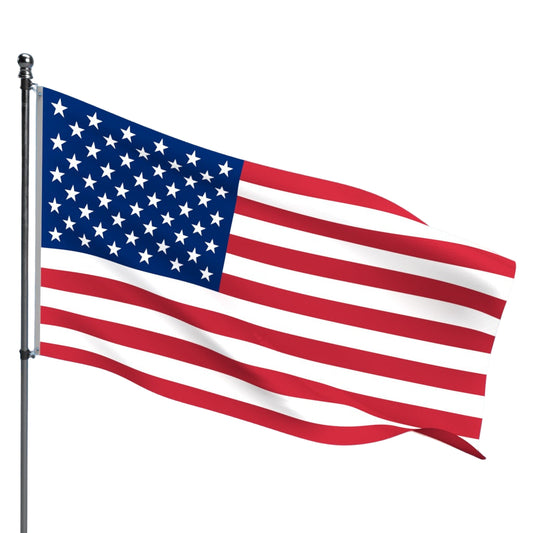
A heavy-duty American flag is constructed from 2-ply spun polyester — two layers of woven polyester fabric rather than one. It features a four-row lock-stitched fly end, a heavy canvas header, and solid brass grommets with tooth washers. The result is a flag that is significantly heavier, denser, and more abrasion-resistant than standard nylon, built specifically for locations where standard flags wear out too quickly.
Heavy-duty flags are the right choice for coastal properties with salt air, open fields and rural locations without windbreaks, commercial buildings and car dealerships on highway frontage, elevated or hilltop sites with consistent wind exposure, and any location where nylon flags have been fraying or fading before the season ends. The simple test: if your last nylon flag lasted less than 3 months, your location calls for heavy-duty polyester.
For a 20 ft residential or light commercial pole, a 3x5 ft flag is standard. For a 25 ft pole, a 4x6 is more proportional. For commercial poles at 30 to 35 ft, a 5x8 is the standard size. For 40 to 45 ft poles, a 6x10 is correct. A good rule of thumb is the flag length should be about one-quarter the height of your pole.
Generally no. Heavy-duty polyester is significantly heavier than nylon and does not fly well on short 5 to 6 ft wall-mount bracket poles where wind speeds are lower. For a standard house bracket, nylon is the correct material. Heavy-duty polyester performs best on taller in-ground and commercial poles where wind is more consistent and strong enough to fill the heavier fabric.
In high-wind or coastal environments where a nylon flag might last 2 to 4 months, a quality 2-ply polyester heavy-duty flag typically lasts 6 to 12 months under the same conditions. In moderate commercial settings it often lasts longer. Bringing the flag in during extreme storm events and inspecting the fly end monthly for early fraying further extends its lifespan.
2-ply spun polyester uses two layers of woven polyester rather than a single layer, making it significantly stronger and more resistant to the whipping, abrasion, and tearing that destroys lighter fabric in sustained wind. The tighter, heavier weave handles salt air, UV, and constant movement far better than single-ply or nylon construction. It is the commercial and institutional standard for locations where flags fly every day.
Look for 2-ply spun polyester fabric, a four-row lock-stitched fly end, a heavy canvas header at the hoist, and solid brass grommets with tooth washers. The fly end is the edge that takes the most punishment in wind — four rows of lock stitching is the standard for commercial-grade durability. Brass grommets with tooth washers prevent tearing at the attachment points under repeated stress.
Yes. Every heavy-duty American flag sold by Tidmore Flags is 100% manufactured in the United States using U.S.-sourced materials. Every flag carries a serialized FMAA certification seal — issued by the Flag Manufacturers Association of America — verifying genuine domestic production. We have been selling American-made flags since 1963.
Yes. All standard heavy-duty polyester American flags include two solid brass grommets with tooth washers on a reinforced canvas header. The tooth washers provide extra grip that prevents the grommets from pulling through the header under high wind load — a key construction detail that cheaper flags skip.
Yes. We offer volume pricing, purchase orders, and tax-exempt purchasing for schools, government buildings, military installations, municipalities, hotels, businesses, and commercial accounts. Contact us at 800-321-3524 for bulk quotes, lead times, and sizing recommendations for your specific application.
Helpful Guides
Related Flag Collections
Need More Help?