Where to Hang an American Flag: A Practical Guide for Homes, Businesses and Churches
"Where should I hang my American flag?" is one of the most common questions we hear from customers. It sounds simple — until you're standing on your porch with a bracket in one hand, a drill in the other, and about 10 different "rules" in your head.

In this guide, we'll walk through the most common real-world situations: front porches, decks, in-ground poles, classrooms, sanctuaries, offices, even flags over a street. We'll cover what the U.S. Flag Code says and how to apply it in everyday spaces so your display looks sharp, respectful, and safe.
Most Common Question: "Where Does This Flag Actually Go?"
Most questions about where to hang an American flag fall into two big categories:
- Residential / building exteriors — porch brackets, decks, house-mounted staffs, in-ground flagpoles.
- Indoor / ceremonial displays — churches, classrooms, stages, auditoriums, lobbies.
From there, the details usually come down to the same few themes:
- Which way the union (blue field with stars) should face.
- What's the position of honor when other flags are involved.
- How to keep the flag off the ground, away from obstacles, and properly lit.
Where to Hang an American Flag Outside Your Home
1. Porch Brackets, Decks & House-Mounted Staffs
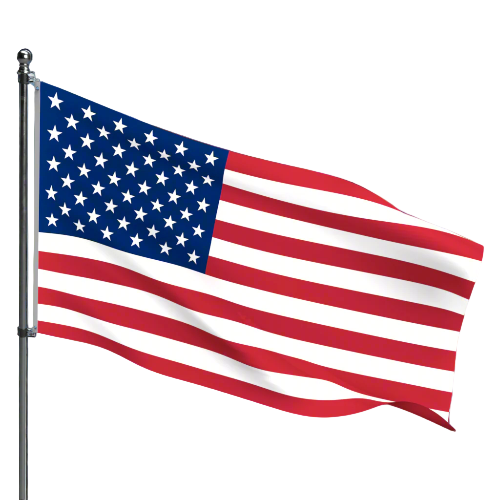
This is the classic home display: a flag on a staff projecting from a porch post, railing, or wall. If you're starting from scratch, a residential flagpole and bracket set makes installation simple.
Simple rule: When the flag is on a staff coming out from the building, the union should be at the peak of the staff (the highest point), unless the flag is at half-staff.
Placement tip: Mount the bracket high enough that the flag can fly freely without rubbing the porch rail, siding, shrubs, or the ground — even on a windless day when it hangs straight down.
2. Hanging the Flag Flat on a Wall or in a Window
Hanging a flag flat against a wall or in a window is where people get turned around — literally. This is true whether you're displaying a large outdoor flag or a smaller style from our indoor American flags collection.
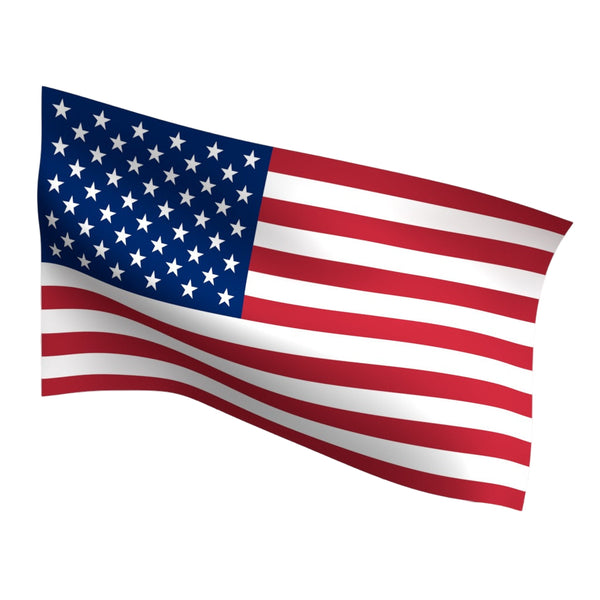
Simple rule: Whether the flag is horizontal or vertical, the union must be in the upper-left corner as the viewer sees it. Stand where most people will view it — the blue field should be at the top left as you face it. In a window facing the street, the union should be in the upper-left corner for someone standing outside looking in.
3. In-Ground Flagpoles
If you're installing a freestanding pole, you're thinking about both etiquette and proportion. Our outdoor flagpoles collection includes residential and commercial poles sized to match common flag sizes.
For a deep dive into selecting the right height, see our full guide: How to Choose the Right Flagpole Height for Your Home or Business.
Flag size vs. pole height: A common rule of thumb is that the flag's length should be about one-quarter the height of the pole — e.g., a 3′×5′ flag on a 20′ pole, 4′×6′ on a 25′ pole, 5′×8′ on a 30′ pole. See the full flag size chart for all sizes.
Position of honor: When you fly state, POW/MIA, or organizational flags on the same halyard, the American flag is always at the peak. It goes up first and comes down last.
Night display: The flag can be flown 24/7 if it's properly illuminated. If you can't see the flag clearly after dark, take it down at sunset.
Need everything in one box? A flag and pole bundle combines a U.S. flag, hardware, and often a state flag so you can install a complete display in one go.
Where to Hang an Indoor American Flag
1. Behind a Pulpit, Altar, or Speaker's Platform
Churches and auditoriums ask about this constantly, because the Flag Code uses formal language that can be confusing in real life. A complete indoor American flag presentation set is the easiest way to get the right pole height, stand, and ornament for these spaces.
Simple rule: When the flag is on a staff in a church or public auditorium, it should be placed at the speaker's right as they face the audience — that's the audience's left. If another flag (state, Christian, organizational) is used, it belongs on the speaker's left, slightly lower or secondary in prominence.
2. Classrooms, Gyms & Auditoriums (Flat Displays)
- When the flag is displayed flat on a wall behind a speaker, stage, or head table, the union must be in the upper-left corner for the audience.
- In a classroom, a wall-mounted flag is usually placed at the front of the room, above and behind the teacher's main teaching area, with the union at the audience's upper left.
Schools often pair an American flag with a state flag from our U.S. state flags collection to represent both the nation and their home state.
3. Bedrooms, Offices & Living Rooms
- If the flag is displayed flat on a wall, the union (blue field with stars) must be in the upper-left corner from the viewer's perspective — whether hung horizontally or vertically.
- A 3′×5′ flag works well for most bedrooms, offices, dorm rooms, or living rooms without overwhelming the space.
- For mounting, use evenly spaced attachment points so the flag hangs flat and does not sag. Removable adhesive hooks, push pins, or small finishing nails are common options depending on your wall type.
4. Hanging a Flag Horizontally on a Wall
- The union (blue field with stars) must be in the upper-left corner from the viewer's perspective.
- Select a clean, flat surface where the flag can hang fully extended without obstruction from furniture, vents, or décor.
- Secure the top corners first, then add support along the top edge or bottom corners to prevent sagging.
- For drywall, small finishing nails or removable adhesive hooks work well. For brick or concrete, use wall anchors designed for masonry.
Less Common, More Confusing Situations
Flag Suspended Over a Street
Displaying a flag over a main street looks impressive — but the orientation matters.
East–west street: the union should face north.
North–south street: the union should face east.
Crossed Staffs with Another Flag
Sometimes you'll see the American flag crossed with a state, military, or organizational flag in a lobby or office.
- The American flag should be on its own right (the observer's left).
- Its staff should pass in front of the other flag's staff.
The Biggest Mistakes We See (And How to Avoid Them)
Union on the wrong side when the flag is hung flat, or flag hung upside down unintentionally. Fix: The union is always upper-left from the viewer's perspective, whether horizontal or vertical.
Flags left up when torn, badly frayed, or extremely faded. Flags flown at night with no lighting. Flags allowed to drag on the ground or over a railing.
Clean or repair flags when dirty. Add flagpole lighting for night display. If your flag is faded, here's why flags fade and what to look for in a replacement. If it's torn beyond repair, retire it respectfully.
Other flags flown above the U.S. flag on the same pole. U.S. flag placed on the wrong side of a stage or pulpit. Using the flag itself as table covering or drapery instead of patriotic bunting.
The American flag is always at the peak on a shared pole — first up, last down. On a stage it belongs to the speaker's right (audience's left).
Height, Clearance & Visibility: What Looks Best and What's Respectful
- Height and proportion: Choose a pole height and flag size that fit the building. A 15–20′ pole with a 3′×5′ flag looks right for most single-story homes; 20–25′ with a 4′×6′ for taller homes or small commercial buildings. See the flag size chart for a full reference.
- Clearance: Make sure the flag can't hit the ground, sidewalk, driveway, roof, gutter, tree branches, or power lines — even in gusty wind.
- Visibility: Think like a visitor. From the main road, parking lot, or walkway, can they clearly see the flag? Is anything consistently blocking the view?
How Local Conditions Change the Advice
Consider a slightly smaller, heavy-duty American flag (like 2-ply polyester) and a stronger pole with a proper wind rating. In severe storms, it's perfectly respectful to take the flag down to protect it.
Fiberglass or high-grade aluminum poles and corrosion-resistant hardware are your friend. Browse our outdoor flagpoles collection for coastal-rated options.
Wall and balcony brackets are usually better than tall in-ground poles. Choose a smaller flag that won't drape over neighbors' space or touch a lower balcony. See our residential brackets collection.
Creative but Respectful Places to Hang an American Flag
- Office or lobby corner: A larger wall-mounted flag high on the wall with correctly crossed floor-stand flags below.
- Memorial garden: A single, well-lit flagpole as the focal point, surrounded by stone or brickwork.
- School stairwell: A tall vertical flat display with the union in the upper-left corner.
- Gym or auditorium: A flat-mounted flag centered high above the main stage or speaking area.
Quick Checklist: Is Your Flag in the Right Place?
- Is the union in the upper-left corner as your main viewer sees it?
- Is the flag high enough that it never touches the ground?
- If flown with other flags, is the U.S. flag highest or in the position of honor?
- If flown at night, is it properly illuminated?
- Is the flag in good condition, without major tears or fading?
Ready to Hang Your Flag the Right Way?
If you're ready to upgrade your setup, choose a Made-in-USA American flag or state flag and a durable flagpole or flag-and-pole starter kit. The right combination of flag, hardware, and placement will give you a display you're proud of every time you pull into the driveway or walk through the front door.
Not sure what setup is right for your property? We've been doing this since 1963 — call us.
800-321-3524 Mon–Thu 8am–5pm · Fri 8am–4pm CSTAbout Tidmore Flags: Tidmore Flags has sold American flags in the United States since 1963. Every flag sold by Tidmore Flags is 100% Made in USA from U.S.-sourced materials and carries a serialized Flag Manufacturers Association of America (FMAA) certification seal verifying genuine domestic production. Tidmore Flags is a member of the FMAA, the National Independent Flag Dealers Association (NIFDA), the National Minority Supplier Development Council (NMSDC), and the National Exchange Club. All orders ship within 1–2 business days. Bulk pricing, purchase order accounts, and tax-exempt orders are available for commercial and institutional buyers.