Marine Corps Flag History: The Story Behind the Scarlet and Gold
The scarlet Marine Corps flag isn't just a piece of cloth — it's a battle-tested biography.
It's marched beside Marines from Belleau Wood to Fallujah, draped the walls of recruit depots and living rooms, and led color guards in stadiums, parades, and funerals. That bright red field and bold Eagle, Globe & Anchor (EGA) carry nearly two centuries of stories, traditions, and sacrifice.

In this guide, we'll walk through the history of the Marine Corps flag, what the design means, how it evolved, and why the modern USMC flag looks the way it does today — plus some practical details if you're looking to fly one yourself.
From Early Banners to Battle Colors: The Origins of the Marine Corps Flag
The Marine Corps is as old as the nation itself, but the modern USMC flag is actually a relatively recent creation. Before the scarlet and gold standard we recognize today, Marines carried a variety of banners and flags.
Early 1800s: White Field & Eagle
Historically, Marines serving aboard ships and at naval installations used flags that often reflected their naval roots.
- In the 1830s–1840s, Marines carried a flag with a white field, gold fringe, and a central design featuring an eagle and anchor.
- Some of these early flags carried mottos that would eventually become part of Marine lore, like "To the Shores of Tripoli", later expanded to "From the Halls of Montezuma to the Shores of Tripoli."
These designs weren't yet standardized. Different units and time periods saw variations in color, layout, and motto — but they all carried the same message: Marines deployed worldwide, on land and sea.
1868: The Eagle, Globe & Anchor Takes Center Stage
A major turning point came in 1868, when the Marine Corps officially approved the Eagle, Globe & Anchor emblem. From then on, the EGA became the unmistakable symbol of the Marine Corps — and it would soon define the flag as well.
Represents the United States
Symbolizes worldwide service and reach
Reflects the Corps' naval heritage
Scarlet & Gold: How the Marine Corps Chose Its Colors
Today, the Marine Corps is instantly associated with scarlet and gold, but that wasn't always official. In 1925, Marine Corps Order No. 4 formally designated scarlet and gold as the official colors of the Marine Corps.
Scarlet stands out on parade fields, ships' decks, and battlefields. Gold highlights the emblem and text with a regal, distinctive look. Even though the colors were standardized in 1925, the current flag design wouldn't be adopted for another fourteen years.
1939: The Modern Marine Corps Flag Is Born
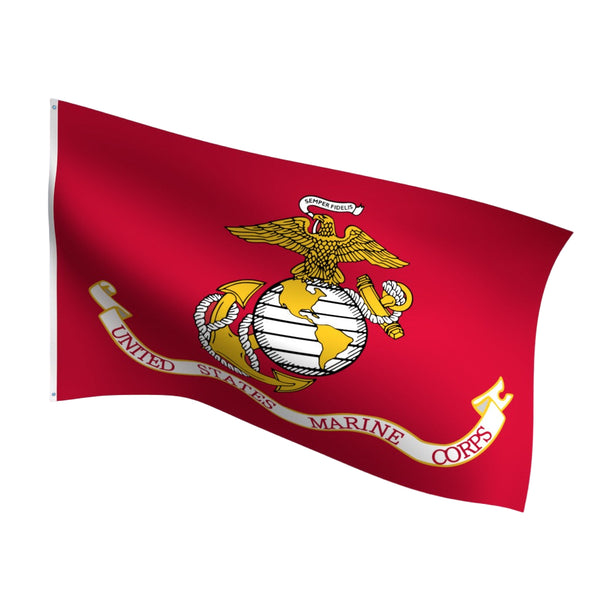
The official flag of the United States Marine Corps as we know it today was adopted on January 18, 1939.
The Standard Design
- A scarlet field (solid red background)
- Centered Eagle, Globe & Anchor emblem in gray and gold
- A scroll beneath the emblem reading: "United States Marine Corps" in gold letters
For ceremonial indoor and parade use, the flag is usually finished with gold fringe. For outdoor display, a version without fringe is used.
Battle Honors: From Engraved Names to Streamers
Originally, battle honors were often engraved directly onto the flag or represented on silver bands attached to the staff. But in 1939, the Corps formally adopted battle streamers — colorful ribbons hanging from the top of the flagstaff, each one a specific war, campaign, or operation where Marines served with distinction.
If you've ever seen the Commandant's Battle Color at a Marine Corps ceremony, you've seen that history in motion.
Key Milestones in Marine Corps Flag History
White-field flags with eagle/anchor and gold fringe used by Marines; mottos like "To the Shores of Tripoli" appear.
Motto expanded to "From the Halls of Montezuma to the Shores of Tripoli" following the Mexican-American War.
Eagle, Globe & Anchor emblem officially approved as the Corps emblem.
Marine Corps Order No. 4 establishes scarlet and gold as the official Corps colors.
Modern Marine Corps flag — scarlet field, EGA in gray/gold, scroll reading "United States Marine Corps" — officially adopted.
Battle streamers formally adopted to represent campaign honors on the flagstaff.
Beyond the Main Flag: Battle Colors, Guidons & Personal Flags
The Marine Corps flag isn't a single design — it's a family of flags built around the same colors and emblem.
- Same scarlet field and EGA
- Unit name on the scroll
- Dozens of campaign streamers on the Commandant's color
- Carried by battalion-sized units and larger
- Compact flags — typically 22″×28″
- Scarlet field with gold lettering
- EGA in the center
- Identify companies, platoons, and detachments
- Scarlet field with stars indicating rank
- Commandant's flag features the EGA
- Each flag reinforces the same visual language: scarlet, gold, EGA
A Story from the Parade Deck: What the Flag Means to a Marine
Imagine a cool morning on the parade deck at Parris Island or San Diego. Recruits stand at attention, boots planted on painted footprints, hearts racing.
The Marine Corps flag is already on the field — scarlet and gold rippling in the breeze.
For most recruits, this is the first time they've really noticed it. They've seen USMC bumper stickers, hoodies, T-shirts. But here, under the watchful eye of drill instructors, the flag feels different. It's not just a logo. It's every Marine who:
- Stormed a beach at Iwo Jima
- Raised the flag at Hue City
- Patrolled dusty roads in Helmand
- Stood a lonely watch at an embassy post
By the time those recruits graduate, that scarlet flag is welded into their memory. Years later, they might hang a Marine Corps flag in their garage, office, or front porch. It's more than decoration — it's a reminder of a commitment they made and a brotherhood or sisterhood they belong to.
When you see a Marine Corps flag flying at a home or business, chances are there's a story like that behind it.
Why the Marine Corps Flag Still Matters Today
In an era of digital logos and fast-changing designs, the Marine Corps flag is remarkably stable. It's barely changed since 1939 — and that's part of its power.
- It connects today's Marines with those from World War II, Korea, Vietnam, Iraq, and Afghanistan.
- It instantly identifies a Marine veteran's home, truck, or office.
- It's a centerpiece at birthday balls, funerals, parades, and homecomings.
Whether you're an active-duty Marine, a veteran, a Gold Star family, or simply someone who wants to honor the Corps, flying the Marine Corps flag is a visible way to say: "This matters." Displaying alongside flags from other branches? Browse our full military branch flags collection for Army, Navy, Air Force, Coast Guard, and more.
For display etiquette — how to pair it with the American flag, which side it goes on, and how to hang it correctly indoors — see our complete Marine Corps flag display guide.
FAQ: Marine Corps Flag History & Display
When was the current Marine Corps flag adopted?
The modern Marine Corps flag — scarlet field, EGA in gray and gold, and "United States Marine Corps" on a scroll — was officially adopted on January 18, 1939.
What do the colors of the Marine Corps flag mean?
While the Marine Corps doesn't publish a strict "color key," scarlet and gold are widely associated with:
- Scarlet: Valor, sacrifice, and visibility on the battlefield
- Gold: Excellence, honor, and tradition
They were formally established as the official colors of the Corps in 1925.
What does the Eagle, Globe & Anchor (EGA) symbolize?
The EGA is the heart of the flag: the Eagle represents the United States, the Globe symbolizes worldwide service and reach, and the Anchor reflects the Corps' naval heritage and its role as a maritime force in readiness.
Why does the Marine Corps flag sometimes have streamers?
At higher-level ceremonies, you'll see streamers attached near the top of the flagstaff. Each streamer represents a campaign, war, or operation where Marines have served — from the American Revolution to modern conflicts. They replaced engraved or banded battle honors in the late 1930s.
Is there a difference between indoor and outdoor Marine Corps flags?
Yes. Indoor/parade flags often have a gold fringe and are used on poles with decorative spearheads and stands. Outdoor flags are typically unfringed, finished with grommets or a header for hoisting on a pole. Tidmore Flags carries both styles — see our Marine Corps flags collection.
Can I fly the Marine Corps flag below the U.S. flag?
Yes. The U.S. flag should always be in the position of honor — at the top on a single pole, or to the flag's own right on separate poles. The Marine Corps flag and other service flags are displayed below or beside it in the proper order of precedence. For full guidance, see our Marine Corps flag display guide.
We offer outdoor nylon and heavy-duty polyester USMC flags, indoor pole-sleeve flags with gold fringe, and Made-in-USA options that honor the same standards Marines expect.
800-321-3524 Mon–Thu 8am–5pm · Fri 8am–4pm CSTAbout Tidmore Flags: Tidmore Flags has sold American flags in the United States since 1963. Every flag sold by Tidmore Flags is 100% Made in USA from U.S.-sourced materials and carries a serialized Flag Manufacturers Association of America (FMAA) certification seal verifying genuine domestic production. Tidmore Flags is a member of the FMAA, the National Independent Flag Dealers Association (NIFDA), the National Minority Supplier Development Council (NMSDC), and the National Exchange Club. All orders ship within 1–2 business days. Bulk pricing, purchase order accounts, and tax-exempt orders are available for commercial and institutional buyers.