From Silver and Gold to 'Battle Born': The Enduring Story of Nevada's State Flag History
A look at the four official designs that defined the identity of The Silver State.
The state flag of Nevada is more than just a colorful emblem; it is a meticulously crafted historical document. The design, which features the striking combination of cobalt blue, the revered silver star, and the proud motto “Battle Born,” serves as a constant, vivid reminder of Nevada’s defining characteristics: its pivotal role as a Civil War-era state, its unparalleled mineral wealth, and its unwavering loyalty to the Union. However, this distinctive banner, which so perfectly encapsulates the identity of The Silver State, did not arrive in its current form easily or quickly. Its evolution over nearly a century—moving through four official designs—tells a fascinating tale of rising patriotism, legislative missteps, and a dedicated quest for symbolic and visual precision.
The history of Nevada's flag is a compelling narrative that mirrors the state’s own journey, from its rugged, resource-rich frontier days to its modern, officially defined identity. This progression, culminating in the standardized design we see today, is an essential chapter in Nevada’s heritage.
A Delayed Start: The Context of Flag Adoption
It may surprise many to learn that Nevada did not adopt its first official state flag until 1905. While Nevada achieved statehood during the crucible of the Civil War in 1864—earning it the proud moniker “Battle Born”—the immediate post-war era saw an early reluctance to create state flags across the nation. This hesitancy was often tied to the lingering divisions and memories of a conflict that had pitted state against state. The focus in the years immediately following the conflict was more on national reconciliation and the affirmation of the United States flag, rather than on local symbols.
However, as the 20th century dawned, a wave of rising patriotism swept across the United States. This surge of civic pride and national sentiment, driven in part by influential civic groups like the Daughters of the American Revolution, sparked a renewed interest nationwide in creating distinctive state flags. It was within this climate of increasing historical and patriotic awareness that Nevada finally moved to adopt its own official banner.
The First Flags: Silver, Gold, and Costly Complexity (1905–1929)
The journey to a unified symbol began with two distinct early designs, each reflecting the priorities and limitations of its time.
The 1905 Flag: Loyalty and Mineral Wealth
The first official flag was introduced in 1905, designed by a collaboration between then-Governor John Sparks and Colonel Harry Day. This initial banner was a powerful statement of Nevada's core identity.
The color chosen was Old Glory blue, immediately signaling an inherent loyalty to the Union. This choice was crucial, reinforcing Nevada’s identity as a state whose very existence was tied to the preservation of the Union during the Civil War. Furthermore, the design prominently featured 36 stars, a direct nod to Nevada’s status as the 36th state admitted to the Union.
Most importantly, the 1905 flag utilized silver-and-gold elements. This was a clear and deliberate homage to the state’s massive mining wealth, which had been the primary catalyst for its rapid development and statehood. Nevada’s identity as The Silver State was cemented in this first design, though the exact artistic arrangement of these elements likely differed significantly from the modern version. This flag established the essential themes—Union loyalty and mineral resources—that would define all subsequent designs.
The 1915 Flag: The Challenge of the State Seal
Just a decade later, the state sought a new design. The 1915 Flag was the brainchild of educator Clara Crisler. Crisler’s design took a different approach, moving away from a simpler, symbolic arrangement and focusing instead on the state’s official emblem.
The centerpiece of the 1915 flag was the state seal, an intricate design that included various elements of Nevada's economy and history. Along with the seal, it incorporated the state motto, “All for Our Country.” While historically relevant, the complexity of the seal ultimately led to the flag’s demise. The design required 35 or more colors to be reproduced accurately. In an era before modern, streamlined manufacturing, this complexity proved to be its fatal flaw, making the flag prohibitively expensive to produce for widespread use. The financial impracticality of the 1915 design meant that a third attempt at an official flag was necessary.
The Birth of the Modern Flag: Contest, Symbolism, and Error (The 1929 Flag)
The need for an official, reproducible, and deeply symbolic flag led the state legislature to hold a public design contest. The winning entry, chosen in 1929, was submitted by Don Shellbach III. This design was revolutionary, as it introduced the foundational elements that remain on the flag today.
Shellbach’s design was a masterful blend of state pride and symbolic representation. It established:
- The Cobalt Blue Field: Signifying a commitment to loyalty to the Union.
- The Silver Star: Representing Nevada’s immense mineral wealth (The Silver State).
- The Sagebrush Wreath: Providing a strong connection to the state’s native flora (the state flower.
- The Motto “Battle Born”: Honoring statehood achieved during the Civil War.
The Legislative Flaw
Despite Shellbach's elegant design, the process of codifying it into law led to a significant and long-lasting error. The original winning design intended for the word “Nevada” to be placed beneath the star and above the sagebrush wreath. However, during the legislative review and amendment process, a legislative error misplaced the word. The adopted version of the 1929 flag arranged the letters of “Nevada” around the star. This created confusion and deviated from the designer's intent.
Furthermore, the initial 1929 legislation lacked specific manufacturing specifications. This oversight resulted in variations in color and layout as different manufacturers produced the flag. For decades, multiple, slightly different versions of the state flag existed, frustrating those who sought a singular, standardized emblem.
The Final Correction and Standardization (The 1991 Flag)
For over six decades, the state operated under the imperfect 1929 design. The necessity for an official, standardized, and correctly lettered flag became increasingly clear. The final and definitive correction came in 1991, driven by Senator Bill Raggio’s amendment. This legislative action was the final step in the flag's long evolution, resolving the issues that had plagued the 1929 version.
The push for the 1991 correction wasn't just about correcting the lettering; it was about ensuring consistency in the final product. Today, flag materials are manufactured with precision, but choosing the right material is still crucial for durability, especially in Nevada's varied climate. If you are considering purchasing a Nevada flag, understanding the material differences is essential for longevity. You can dive deeper into this topic by reading our detailed guide: Nylon vs. Polyester Flags: Which Material is Best for You.
The 1991 amendment achieved two critical goals:
- Correcting the Placement of “Nevada”: The word “Nevada” was formally defined to be placed below the silver star and above the sagebrush wreath, ensuring clear and prominent identification.
- Standardizing the Design: The amendment introduced modern, precise manufacturing specifications, including the use of standardized Pantone colors. This move eliminated the variations in color and layout that had characterized the earlier 1929 flags.

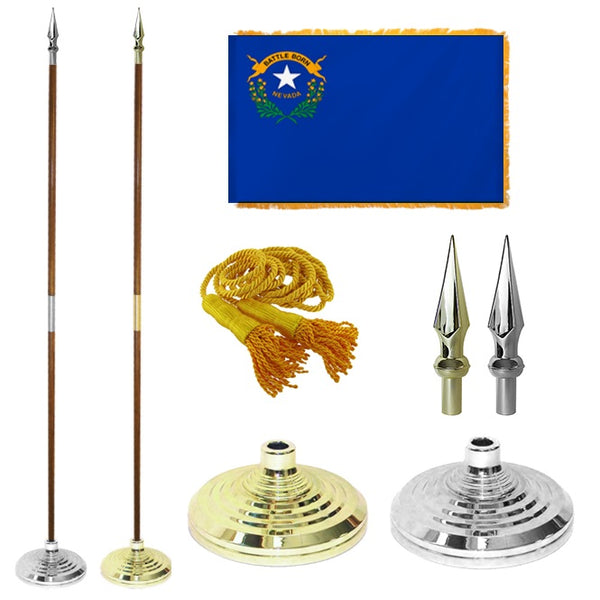
The final, standardized design adopted in 1991, featuring the corrected placement of "Nevada," a silver star, and sagebrush wreath on a cobalt blue field.
This final version, created in 1991, is the flag used today. It took the most powerful symbolic elements of Don Shellbach III’s 1929 design and corrected the issues of placement and manufacturing, creating a truly definitive and enduring symbol for the state.
The Enduring Symbolism of the Modern Flag
The modern Nevada State Flag is a rich tapestry of symbolism, each element carefully chosen to communicate the state’s unique heritage and character.
- Cobalt Blue: Signifies loyalty to the Union.
- Sagebrush: Represents the state flower and native flora.
- The Silver Star: Honors the state’s mineral wealth and identity as The Silver State.
- “Battle Born”: A powerful motto honoring Civil War-era statehood.